> System Console Initialized. Standby for K.E.C. transmissions...

> All traces of user activity will be logged. You are being watched.

> Last login: Unknown

No matter where you go, everyone's connected.

Layer 01: Iwakura Lain

An exploration of self in a world increasingly mediated by technology. Lain's journey is one of fragmented identity, profound alienation despite ubiquitous connectivity, and the desperate search for genuine connection and understanding in the cacophonous realms of the digital and physical. The series probes whether a 'true self' can even exist when perception is malleable and presence is fractured across multiple realities.
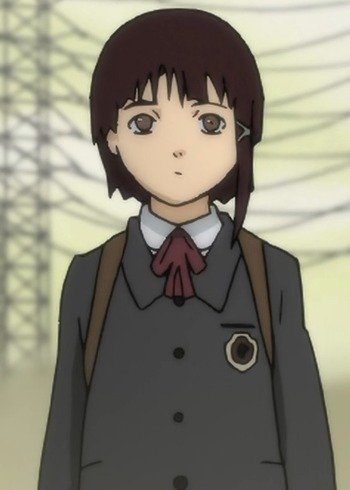
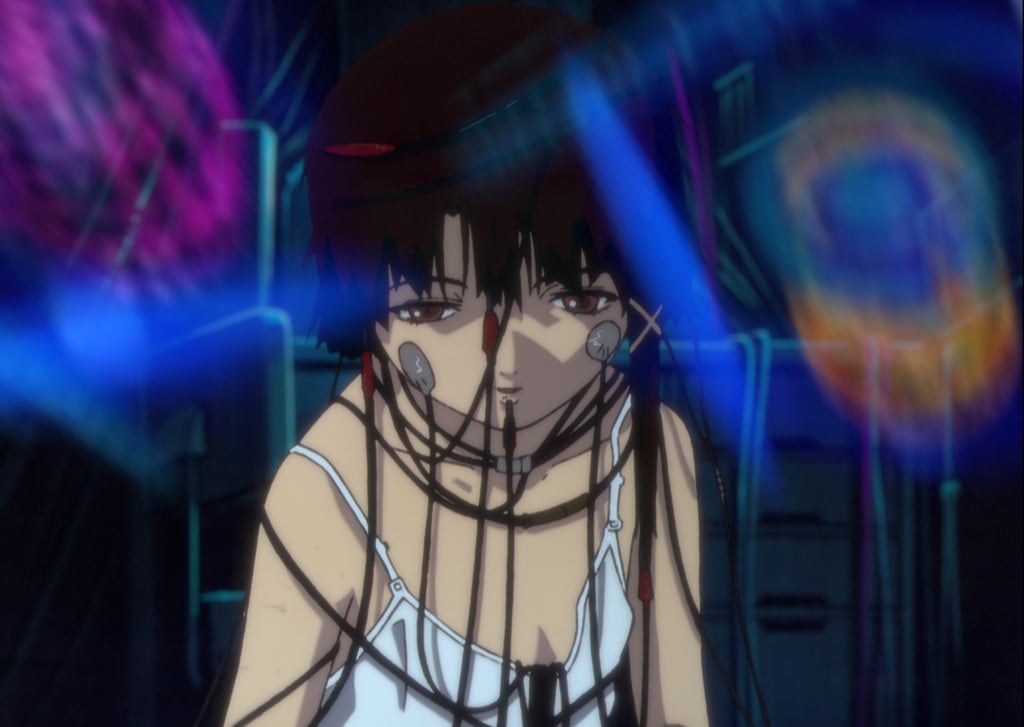
Image of Lain in her quiet, everyday school persona Image of Lain's bolder, more assertive Wired persona

who_am_i.txtDetailed character deconstruction and the philosophical underpinnings of Lain's shifting identities.

Lain Iwakura initially appears as a shy, almost pathologically introverted 14-year-old junior high student, uncomfortable with technology and social interaction. As she receives her first NAVI and delves into the Wired, her personality begins to fracture and evolve. We witness multiple "Lains": the timid schoolgirl, the curious and increasingly adept Wired user, a bolder and sometimes malicious online persona, and ultimately, a being whose very nature transcends conventional definitions of human, program, or concept. The series forces us to question: Is identity an intrinsic quality or a performance shaped by environment and perception? Is the "real" Lain the one in the physical world, or the one gaining omnipotence in the Wired? Her familial relationships, particularly her detached parents and the later-revealed artificiality of her sister Mika, further destabilize her sense of self, suggesting her entire existence might be a construct.

faces_in_the_wired.logAnalysis of Lain's online personas and their interactions, highlighting the fluidity and performativity of digital identity.

The Wired offers a space for anonymity and radical self-reinvention, which Lain experiences firsthand. She encounters various manifestations of "Lain" online – some are echoes of her own burgeoning personality, others seem to be autonomous entities or malicious rumors spread by the Knights. This exploration of online personas comments on the nature of digital identity: Are they extensions of our true selves, carefully curated masks, or entirely separate beings? The reactions of Alice Mizuki and her other classmates to the "Wired Lain" (who is rumored to be more outgoing, aggressive, or even cruel) highlight the disconnect between physical and digital reputation and the ease with which misinformation can define an individual in the networked age.
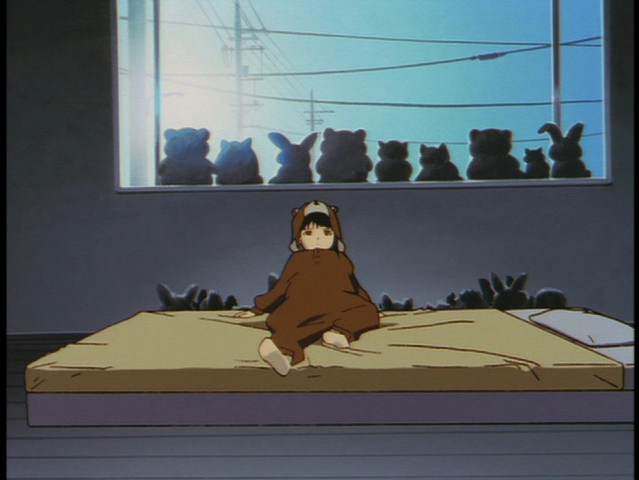
Iconic image of Lain's bear pajamas

empty_room.datSymbolism of Lain's physical environment (bear suit, sparse room, power lines) and its reflection of her internal state of isolation.

Lain's iconic bear kigurumi pajamas and her stark, almost barren room are powerful symbols of her profound loneliness and childlike vulnerability. The bear suit acts as a comforting shield against a confusing world, while the room, initially empty save for her NAVI, reflects her lack of connection and personal history. As her NAVI setup becomes increasingly complex and overwhelming, it mirrors her immersion in the Wired and the erosion of her physical-world identity. The omnipresent hum of power lines outside her window serves as a constant reminder of the Wired's pervasive influence, an invisible network that both connects and isolates.
Layer 02: The Wired

The Wired is depicted not merely as a global communication network analogous to the internet, but as a distinct, almost sentient layer of reality—a collective human unconscious made tangible and interactive through advanced technology. It promises unprecedented connection and knowledge, yet it harbors unforeseen complexities, existential dangers, and the potential for absolute control or dissolution of self.

Conceptual diagram of Protocol Seven network architecture

protocol_seven.infoIn-depth explanation of Protocol Seven, its theoretical capabilities, and its role in Eiri Masami's plan.

Protocol Seven is the mythical next-generation internet protocol, engineered by Masami Eiri. It's suggested to allow for a seamless, wireless, and direct interface between human consciousness and the Wired, effectively eliminating the need for physical NAVI devices. This protocol would enable the collective unconscious to be fully integrated and experienced by everyone, everywhere, essentially merging the physical and digital realms. Eiri believes this is the key to humanity's evolution, but it also carries the inherent risk of erasing individuality and enabling god-like control by its architect.

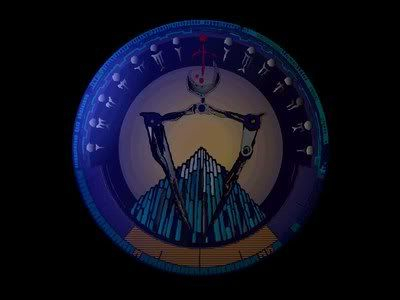
Detailed or stylized logo of the Knights of the Eastern Calculus

knights_of_the_eastern_calculus.usrDeep dive into the Knights: their ideology, methods (Psyche processor), and their manipulation of Lain.

The Knights of the Eastern Calculus (K.E.C.) are an enigmatic and elite group of hackers who view themselves as clandestine guardians and shapers of the Wired's evolution. They believe in Masami Eiri's vision and actively work to bring about the full implementation of Protocol Seven. Their methods are subtle yet pervasive, including the dissemination of Psyche processors (allowing for enhanced, albeit risky, Wired access), spreading misinformation, and directly manipulating individuals like Lain, whom they see as a crucial component—or perhaps a messianic figure—in their grand design. Their ultimate goal is to unify all consciousness within the Wired.

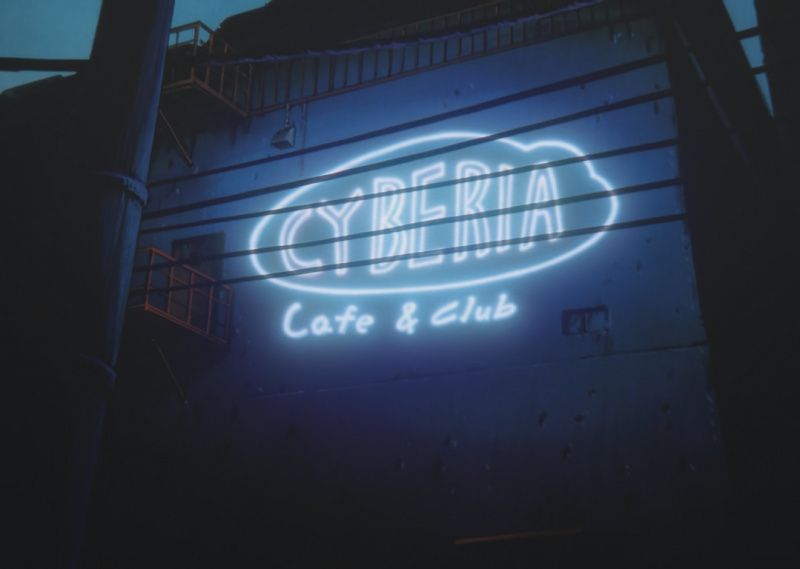
Atmospheric depiction of the Cyberia nightclub's virtual counterpart in the Wired

cyberia_club_flyer.jpgExploration of Cyberia as a microcosm of the Wired: information hub, social experiment, and danger zone (Accela).

Cyberia is a popular, pulsating nightclub that exists both in the physical world and as a prominent node within the Wired. It serves as a key social hub for tech-savvy youth, hackers, and those seeking escape or alternative experiences. It's a place where information, rumors, and new technologies (like the psychoactive drug Accela, which enhances Wired perception) flow freely. For Lain, Cyberia is a critical space for social awakening, encountering key figures like Taro and the Knights, and experiencing firsthand the allure and dangers of unchecked digital interaction and subcultures.

> INITIALIZING CONNECTION TO THE WIRED...

> NODE CLASSIFICATION: UNRESTRICTED ACCESS POINT (UAP)

> AUTHENTICATION REQUIRED: BYPASSING VIA K.E.C. BACKDOOR...

> WARNING: Unidentified signals modulating carrier wave. Possible data corruption. Proceed with caution.

> MASAMI EIRI (LOG_FRAGMENT): "The body is merely a device for processing sensory information. The true self, consciousness, can and will exist independently within The Wired. This is not death; it is evolution."

> KERNEL PANIC: ANOMALOUS ENTITY 'LAIN_GHOST' DETECTED. SYSTEM UNSTABLE.

Layer 03: Reality Distortion

As Lain becomes increasingly enmeshed in the Wired, the conventional boundaries between the physical world (Real World) and the digital realm (The Wired) begin to warp and dissolve. This layer explores the terrifying malleability of memory, the pervasive manipulation of perception, and the encroaching paranoia that defines Lain's subjective experience as objective reality itself becomes suspect.

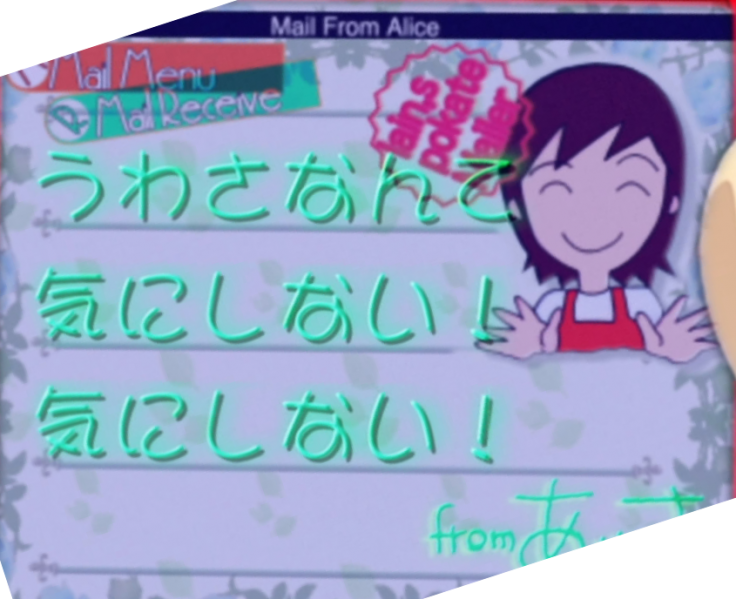
Stylized email signature or fragmented text from Chisa Yomoda's email

chisa_yomoda_email_archive.zipThe inciting incident: analysis of Chisa's post-suicide emails and their philosophical implications on death and digital existence.

The narrative pivot occurs when Lain and her classmates receive emails from Chisa Yomoda, a girl who recently died by suicide. Chisa's message, "I have only abandoned my body. I still live here [in the Wired]," and her claim to have "found God," serves as the primary catalyst for Lain's journey. This event immediately challenges conventional notions of death, suggesting that consciousness can persist, or even find a new form of existence, within the digital plane. It's the first major crack in Lain's understanding of reality, pulling her towards the mysteries of the Wired.

memory_corruption.errExploration of how memory is manipulated, fragmented, and rewritten in the series, questioning the reliability of personal and collective history.

A core theme is the extreme unreliability and malleability of memory. The Wired, and entities within it like the Knights or Eiri Masami, demonstrate the power to alter, implant, or erase memories on both individual and societal scales. Lain's own family history becomes suspect, her sister Mika undergoes a disturbing transformation and then seems to vanish from existence as if never there, and public knowledge of events is shown to be fluid. If memories, the building blocks of identity and shared history, can be so easily corrupted or rewritten, what then constitutes "truth" or a stable reality? This creates a profound sense of ontological insecurity.

>> SYSTEM_ALERT: MEMORY_INTEGRITY_COMPROMISED. BLOCK 0x04F7B1 - 0x04F9C3 CORRUPTED.
>> ACTIVE RECOLLECTION PROTOCOL FAILED. CAUSE: EXTERNAL DATA INJECTION.
>> LAIN_IWAKURA_RECORDS: CONTRADICTORY ENTRIES DETECTED. SISTER_MIKA.DAT -> STATUS: NULL_REFERENCE_EXCEPTION.
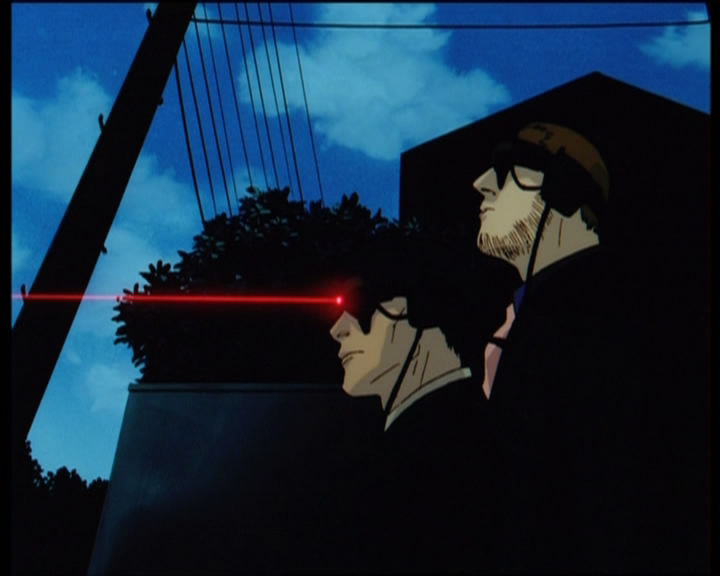
Silhouette of a Man in Black holding an unknown device

mib_report.redactedThe Men in Black: their ambiguous role, connection to Tachibana Labs, and their surveillance of Wired-sensitive individuals.

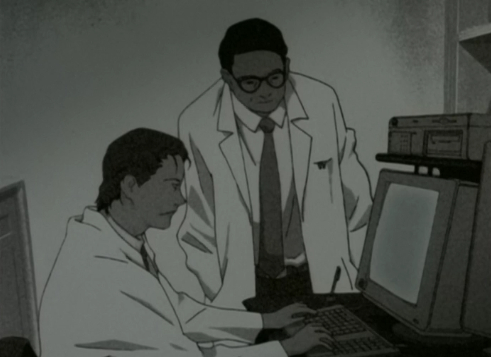
The enigmatic Men in Black (Karl Haushoffer and Lin Sui-Xi) are shadowy agents seemingly affiliated with Tachibana Labs, the creators of the NAVI computers and the Psyche processor. Their purpose remains largely obscure; they monitor Lain and other individuals sensitive to advanced Wired phenomena, occasionally intervening to deliver cryptic warnings or to subtly guide events. Are they protectors trying to prevent a catastrophe, manipulators with their own agenda, or simply dispassionate observers of a grand experiment? Their presence amplifies the series' pervasive paranoia and the sense that powerful, unseen forces are constantly at play, watching and potentially controlling.

Layer 04: Philosophy

Serial Experiments Lain is renowned for its dense philosophical tapestry, weaving together complex questions about the nature of consciousness, the definition of existence, the concept of God in a technologically saturated world, transhumanist ambitions, and the profound impact of digital technology on individual identity and societal structures. It doesn't offer easy answers, instead challenging viewers to engage in deep introspection.

god_in_the_machine.phiMasami Eiri's god complex, the idea of digital divinity, and the theological implications of an omniscient, omnipresent Wired.

Masami Eiri, a lead developer for Tachibana Labs and the architect of Protocol Seven, believes he has transcended his physical limitations by uploading his consciousness into the Wired, effectively becoming its self-proclaimed god. His ambition is to merge all of humanity into this digital realm, liberating them from the "constraints" of the flesh. This plotline explores themes of Gnosticism (the physical world as flawed, spirit/information as pure), the human desire for transcendence, and the ethical and theological questions arising when technology allows one to aspire to omnipotence and omnipresence. Is a god created by humans still a god? What are the implications for free will if such a being exists?

"I am not a god. I am... an administrator. The Wired is vast, and I simply manage its data flows. But to those within, am I not indistinguishable from a deity?" - Eiri Masami (conceptual quote)

collective_unconscious.psiThe Wired as a technological manifestation of Jung's collective unconscious; connections to memetics and shared human experience.

The Wired is frequently interpreted as a modern, technological analogue to Carl Jung's concept of the collective unconscious—a shared reservoir of human experiences, memories, archetypes, and myths that transcends individual minds. Lain's ability to connect with and influence this vast network suggests technology could provide a new medium for accessing and interacting with these deep-seated psychic structures. This ties into ideas of memetics (ideas as self-replicating units) and how information, true or false, can propagate and shape collective belief in the digital age, effectively creating shared realities or delusions on a massive scale. Vannevar Bush's "Memex" concept and Ted Nelson's Project Xanadu are early theoretical frameworks that resonate with this idea of interconnected knowledge.

human_connection.netThe dichotomy of hyper-connectivity and profound loneliness; the search for authentic relationships in a mediated world.

A central paradox explored in Lain is the simultaneous offering of ubiquitous connectivity by the Wired and the profound sense of isolation experienced by its characters, particularly Lain herself. Despite being "connected" to everyone, the series questions whether these digital interactions can truly substitute for genuine, empathetic human relationships and physical presence. It probes whether technology ultimately fosters deeper understanding or creates new, more insidious forms of alienation by mediating experiences and encouraging performative identities. Lain's poignant relationship with Alice Mizuki underscores this theme, as Alice becomes her only tangible anchor to a shared, empathetic reality.

> SYSTEM_QUERY: Define 'connection'. Does bandwidth equate to empathy? Is a shared hallucination a shared experience? Processing...

Layer 05: Echoes

The influence of Serial Experiments Lain reverberates far beyond its original 1998 broadcast. Its prescient themes, unique visual style, experimental narrative, and philosophical depth have cemented its status as a cult classic, inspiring countless discussions, academic analyses, artistic homages, and a dedicated global fanbase. This layer explores its enduring legacy and the community it fostered.

abeyoshitoshi_sketches.galleryAnalysis of Yoshitoshi ABe's art: its unique characteristics, contribution to the series' atmosphere, and influence.

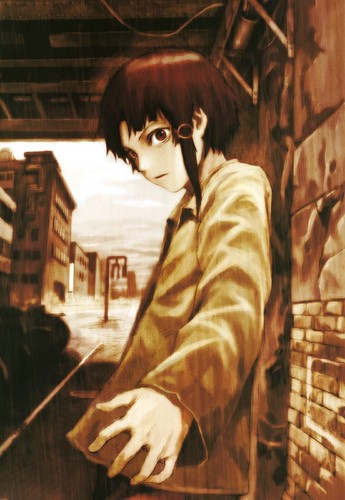
Yoshitoshi ABe's distinctive character designs and hauntingly atmospheric artwork are inseparable from Lain's identity. His style—characterized by elongated figures, large and expressive yet often vacant or melancholic eyes, muted color palettes, and a masterful use of shadow and negative space—perfectly captures the series' themes of isolation, alienation, and the uncanny. ABe's art doesn't just illustrate the story; it breathes life into its unsettling mood and has significantly influenced a generation of artists. The visual motif of pervasive shadows, for instance, often symbolizes the unknown, the repressed, or the encroaching influence of the Wired.

Conceptual artwork by Yoshitoshi ABe featuring Lain and powerlines

developer_logs.txtInsights into the anime's production: the creative team (Chiaki J. Konaka), experimental approach, and budget constraints.

Serial Experiments Lain was produced by Triangle Staff and conceived by a core creative team including producer Yasuyuki Ueda, writer Chiaki J. Konaka, character designer Yoshitoshi ABe, and director Ryūtarō Nakamura. Konaka's writing is known for its dense, layered narratives that often explore cyberpunk, conspiracy, and psychological themes. The anime was a groundbreaking project, particularly for its time, lauded for its experimental storytelling, non-linear plot, and its willingness to tackle complex philosophical ideas. Its often minimalist animation and reliance on atmosphere were partly due to budget constraints, but these limitations were arguably transformed into a unique and effective aesthetic that enhanced its unsettling and introspective qualities.

theories_board.forumOverview of prominent fan theories, ongoing discussions, and Lain's influence on subsequent media and internet culture.

The profound ambiguity and open-ended nature of Lain have fueled decades of fan theories and interpretations. Online forums, imageboards, and social media continue to host passionate discussions dissecting its symbolism, debating the "true" nature of Lain and the Wired, and exploring its many philosophical threads. Common topics include:

  • The Gnostic interpretations of Masami Eiri and the Wired.
  • Lain as a Bodhisattva figure or a Tulpa.
  • The meaning of the "reset" at the end of the series.
  • Predictions of internet culture, social media alienation, and digital identity.
  • Connections to the works of Philip K. Dick, David Lynch, and other avant-garde creators.

Lain's influence can be seen in subsequent anime (e.g., *Ergo Proxy*, *Texhnolyze*, aspects of *Ghost in the Shell: Stand Alone Complex*), video games, and even academic discussions on cyberculture, identity, and posthumanism. It remains a touchstone for art that grapples with the human condition in an increasingly technological world.

Disclaimer: Online communities are complex, evolving entities. Engage with respect and critical thought. Not all signals are true. Information can be a virus. Memory is not read-only.

> WIRED_FORUM_ARCHIVE_ACCESS:

>> User_ Ψ : Is Lain's bear suit a metaphor for childhood innocence lost or a shield against the overwhelming data of the Wired?

>> NetNomad77: The Knights weren't evil, just misguided idealists. Eiri was the real threat.

>> Alice_Online: What if Alice is the only "real" person and everyone else, including Lain, is part of her dream in the Wired?

Layer 06: Interface_L

Connect to a fragmented consciousness. What does Lain want to say? Or what do you want her to say?

// Lain_Interface v1.3 initialized. Awaiting user prompt.

// Connection established... maybe.